




































Unjustified Blockade and the Limits of Unilateralism......
A high-stakes move in a vital global chokepoint raises questions no one is ready to answer—who really pays the price?

Unjustified Blockade and the Limits of Unilateralism
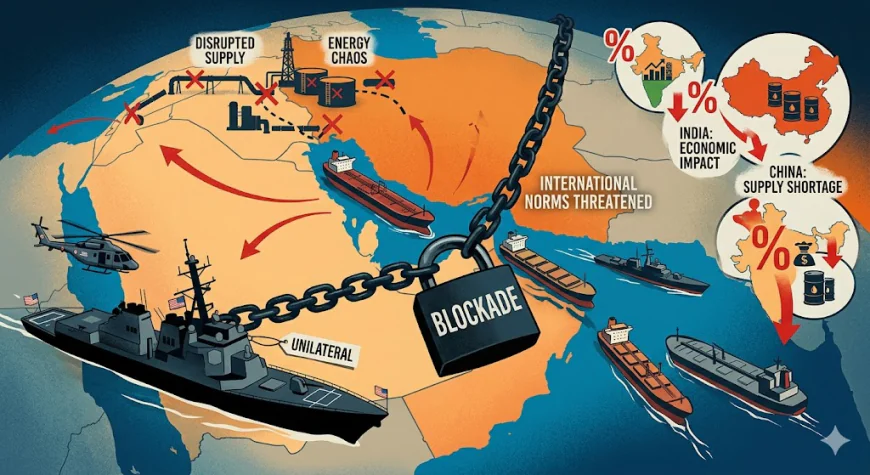
The recent failure of talks between Iran and the United States in Islamabad has been followed by Washington’s decision to impose a naval blockade in the Strait of Hormuz. Framed as a measure to compel Iran back to negotiations, the move raises serious concerns over its legality, intent and wider geopolitical consequences.
The Strait of Hormuz is a critical global choke point governed by principles of free navigation under international law. A unilateral blockade, even if termed “impartial”, risks undermining these norms. More importantly, major stakeholders such as India and China—both heavily dependent on energy flows through the Strait—were excluded from the decision-making process, yet stand to bear disproportionate economic costs. This asymmetry weakens the legitimacy of the action and highlights the democratic deficit in global security governance.
Beyond legality, the blockade reflects a deeper geoeconomic calculus. Disruptions in oil supply chains inevitably exert inflationary pressures worldwide, affecting emerging economies the most. In this context, the move appears less about denuclearisation and more about strategic signalling in an era of intensifying great power competition, particularly vis-à-vis China.
The episode also exposes structural weaknesses within Asian regionalism. Persistent bilateral rivalries and the absence of cohesive institutional frameworks have enabled external powers to shape regional outcomes. Reliance on non-regional actors for security management not only constrains sovereignty but also fragments collective bargaining capacity.
Ultimately, the Iran issue cannot be reduced to a single dimension. It intersects security, energy, and economic stability. Addressing it requires inclusive diplomacy and adherence to international norms, rather than unilateral coercive measures that risk deepening global and regional fault lines.
by shreeram...