


































Delimitation’s Dilemma in India: Constitutional Tensions, Population-Based Representation, Women’s Reservation Link, and the Growing Federal Imbalance Ahead of the 2026 Census Debate
As the upcoming Census approaches, a complex constitutional and political debate is intensifying over the future of representation and seat allocation. Concerns are being raised about balancing demographic realities with ongoing reforms, with potential implications for India’s federal structure and political equilibrium.

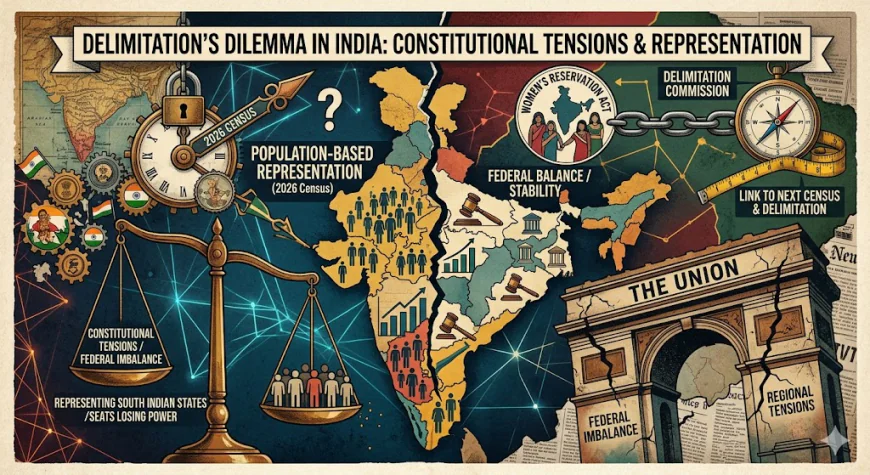
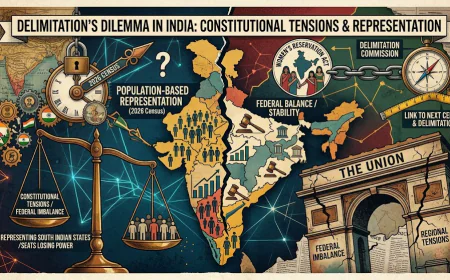
As India approaches a long-delayed Census, delimitation has re-emerged as a politically sensitive and constitutionally complex exercise. Article 82 mandates periodic readjustment of parliamentary representation based on population. Yet, this principle sits uneasily with the prolonged freeze on seat redistribution—first imposed by the 42nd Amendment and extended until 2026 by the 84th Amendment—to incentivise population control.
The current debate has been sharpened by the government’s proposal to operationalise women’s reservation, introduced through the 106th Constitutional Amendment, alongside delimitation—reportedly using 2011 Census data. This raises legal and normative concerns. The constitutional scheme clearly envisages post-2026 delimitation based on a fresh Census. Any deviation risks undermining procedural integrity and invites judicial scrutiny.
More significantly, the exercise exposes a structural limitation: the Constitution privileges population as the sole determinant of representation, without accommodating demographic performance. Southern States, which have achieved replacement-level fertility, fear a disproportionate loss of seats—a “representational penalty” for successful population stabilisation. This could alter the federal balance, influencing fiscal transfers, policy priorities, and political voice.
While proportional representation is foundational to India’s democratic design, its rigid application in a demographically uneven Union may produce unintended inequities. Proposals such as weighted representation or safeguards for States that achieved demographic targets remain outside the constitutional framework.
By linking women’s reservation with delimitation, the government risks conflating two distinct reforms. Such coupling may be viewed as a form of “colourable legislation,” inviting courts to examine each measure independently. A credible path forward demands transparency, constitutional fidelity, and a broader political consensus that reconciles representation with federal equity.
By Shreeram