

































The Costs of Unsustainable Urbanisation: Bengaluru’s Water Crisis....
Once known as the “Garden City,” Bengaluru is now facing a growing struggle that is changing everyday life in unexpected ways. As the city expands and demand rises, a quiet imbalance is beginning to show—raising questions about how long it can continue like this.

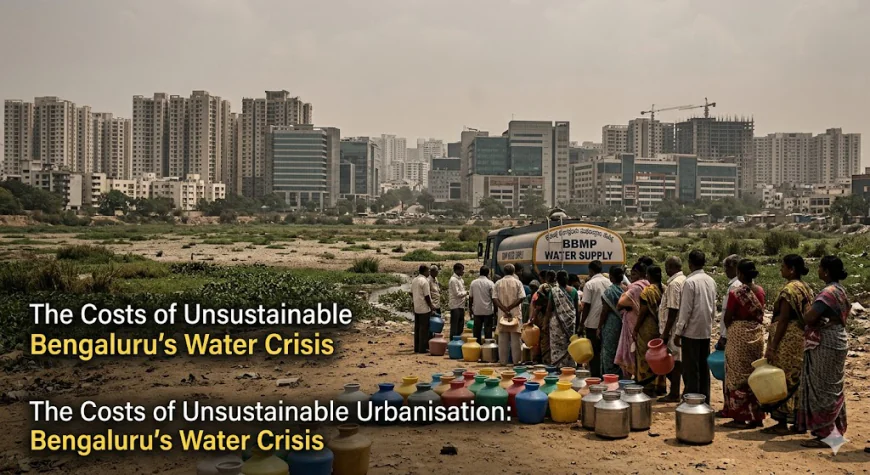
Bengaluru’s water crisis marks a sharp departure from its legacy as the “Garden City,” revealing the ecological costs of rapid and unplanned urbanisation. Situated on hard crystalline rock with limited natural aquifers, the city historically relied on an intricate network of lakes and wetlands for water storage and groundwater recharge. However, the IT-led urban boom has led to their widespread encroachment and degradation, undermining this traditional system.
The proliferation of concretised surfaces has significantly reduced rainwater percolation, resulting in declining groundwater levels. Urban expansion has far exceeded the city’s ecological carrying capacity, pointing to systemic governance failures. Simultaneously, rising incomes and consumption patterns have increased per capita water demand, widening the gap between supply and sustainability.
An unregulated dependence on borewells has aggravated the crisis, while poor wastewater management has contaminated existing sources. Regulatory measures such as rainwater harvesting remain inadequately enforced. The result is a paradoxical urban condition—acute water scarcity during summers and recurrent flooding during monsoons.
The rise of the private tanker economy further reflects institutional shortcomings. Exploiting scarcity, tanker operators extract and sell groundwater at high prices, deepening socio-economic inequities. While affluent residents secure access, vulnerable populations face disproportionate hardships.
Bengaluru’s predicament extends beyond water scarcity; it exemplifies the consequences of unsustainable urban growth. Addressing it requires restoring lake ecosystems, regulating groundwater extraction, promoting wastewater reuse, and strengthening governance frameworks. Without a shift from reactive expansion to sustainable planning, the city risks entrenching long-term ecological and social vulnerabilities.
by shreeram...