






























Chita Andolan: When Development Begins to Burn Tribal Rights
The ‘Chita Andolan’ against the Ken–Betwa River Linking Project highlights a growing conflict between development goals and tribal rights, where displacement threatens not just land, but identity and survival.
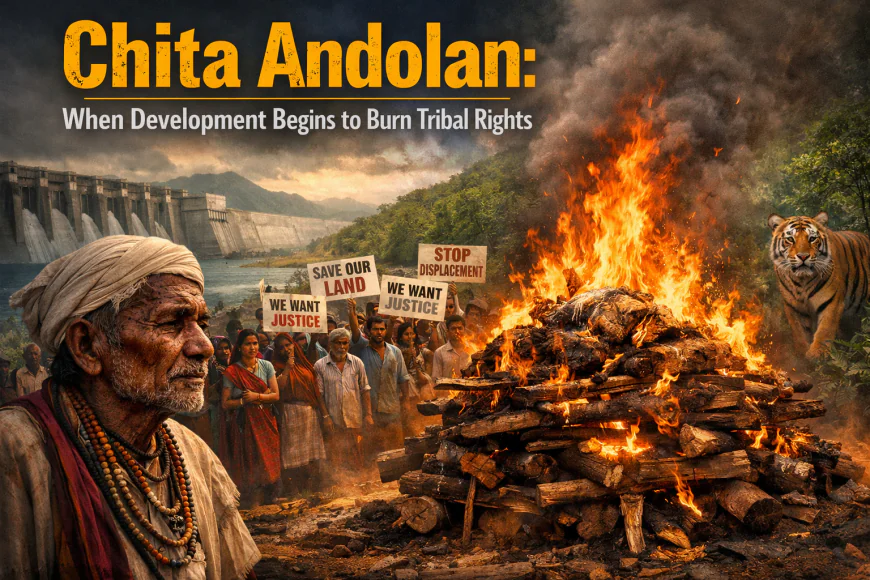
Large-scale development projects in India have long been framed as engines of progress, promising economic growth and regional transformation. However, the emerging ‘Chita Andolan’ against the Ken–Betwa River Linking Project reveals a far more complex and troubling reality—one where development risks colliding with legality, environmental sustainability, and the fundamental rights of tribal communities.
The Ken–Betwa River Linking Project is envisioned as a solution to chronic water scarcity in the drought-prone Bundelkhand region. By transferring water from the Ken River to the Betwa basin, the project aims to boost irrigation, improve drinking water access, and support regional development. Yet, its implementation has exposed significant procedural gaps and ethical concerns.
A particularly striking issue is the phenomenon of dual displacement. Of the 24 villages affected, eight are set to be submerged due to the dam construction and fall under the provisions of the Land Acquisition, Rehabilitation and Resettlement (LARR) Act, 2013. Meanwhile, sixteen villages are being relocated to facilitate the expansion of the Panna Tiger Reserve under the Wildlife Protection Act, 1972. This overlapping framework has created legal ambiguity and inconsistent rehabilitation measures, leaving affected communities in a state of uncertainty.
Equally concerning is the inadequate implementation of the Forest Rights Act, 2006. In many cases, community forest rights have not been formally recognized, undermining legal protections meant to safeguard indigenous populations. This raises serious questions about the legitimacy of the displacement process itself.
Procedural integrity has also come under scrutiny. The consent of Gram Sabhas—an essential pillar of participatory governance—is alleged to have been obtained years earlier, often without ensuring informed awareness among community members. As a result, what is presented as democratic consent may, in reality, lack transparency and genuine participation.
Rehabilitation efforts further deepen the crisis. Compensation has largely been limited to monetary payouts, ignoring longstanding demands for “land for land” and “village for village.” For tribal communities, whose social, cultural, and economic systems are deeply tied to land, cash compensation alone cannot replace what is being lost.
Adding to these concerns is the shrinking democratic space surrounding the protest. Restrictions on dissent and the branding of protestors as “anti-development” reflect a troubling trend where dialogue is replaced by suppression. This not only weakens democratic institutions but also alienates communities whose voices are crucial in shaping inclusive development.
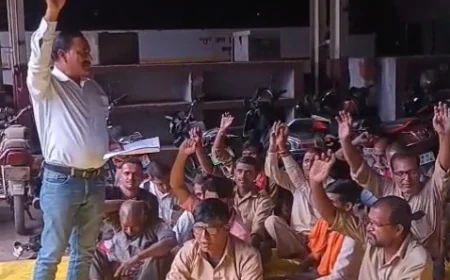
In this context, the ‘Chita Andolan’—symbolized by the act of lighting funeral pyres—emerges as a powerful expression of existential anxiety. For the affected communities, displacement is not merely a physical relocation; it represents the erasure of identity, culture, and historical continuity.
Ultimately, the movement underscores a critical lesson: development cannot be sustainable or legitimate if it is divorced from legal safeguards, ecological balance, and the informed consent of the people it seeks to impact. The Chita Andolan serves as a stark reminder that progress, if pursued without justice, risks leaving behind irreversible social and environmental scars.