


































Resilient Globalisation: India’s New FTA Strategy Reshapes Trade Diplomacy

India’s FTA strategy promotes resilient globalisation with diversified trade, stronger supply chains, and export growth while safeguarding key domestic sectors.


Apr 28, 2026 - 21:01
Apr 28, 2026 - 21:02
Resilient Globalisation: India’s New FTA Strategy Reshapes Trade Diplomacy

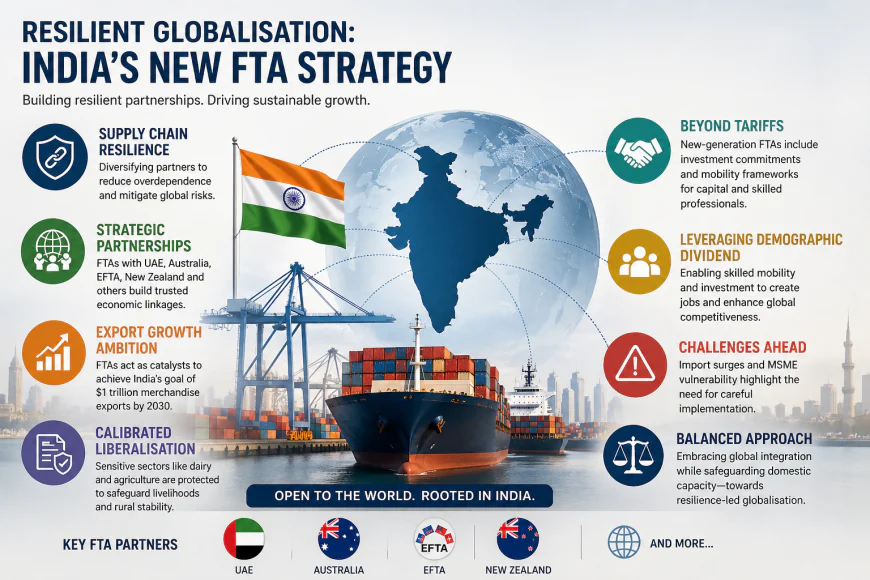
India’s recent Free Trade Agreement with New Zealand is more than a routine bilateral trade deal—it represents a clear signal of the country’s evolving approach to global economic engagement. In a world increasingly marked by fragmented supply chains, geopolitical tensions, and rising protectionism, India is reshaping its trade strategy to prioritise resilience over dependency.

The experience of the Covid-19 pandemic exposed deep vulnerabilities in global supply networks. In response, India has begun actively pursuing a more diversified and secure trade architecture. Rather than relying heavily on a limited set of partners, it is expanding economic linkages through carefully negotiated Free Trade Agreements with countries and blocs such as the UAE, Australia, EFTA, and now New Zealand.

This shift is also influenced by geopolitical realities. Growing tensions with China and the increasing use of trade restrictions, export controls, and sanctions in global politics have underscored the risks of overdependence on single markets or supply sources. India’s strategy, therefore, reflects a process of calibrated de-risking—strengthening ties with trusted partners while safeguarding national economic interests.

A key objective behind this FTA expansion is India’s ambition to reach $1 trillion in merchandise exports by 2030. These agreements are designed to improve market access, reduce trade barriers, and create a more predictable regulatory environment for exporters. This is expected to boost competitiveness, especially for sectors with high growth potential.

At the same time, India has maintained a cautious and selective approach. Sensitive sectors such as dairy and agriculture remain protected, recognising their critical role in rural livelihoods and food security. This balanced approach highlights India’s attempt to integrate globally without destabilising domestic economic structures.

Modern FTAs signed by India are also becoming more comprehensive in nature. They go beyond tariff reductions to include provisions on investment flows, services trade, and mobility of skilled professionals. This reflects a strategic effort to leverage India’s demographic advantage and strengthen its position in global value chains.

However, challenges remain. Concerns over sudden import surges and the potential vulnerability of Micro, Small and Medium Enterprises (MSMEs) continue to shape domestic debates around trade liberalisation. Policymakers must ensure that integration with global markets does not come at the cost of domestic industrial stability.

Ultimately, India’s emerging FTA strategy reflects a nuanced balance—between openness and protection, integration and autonomy. It marks the beginning of a new phase of resilience-led globalisation, where economic diplomacy is increasingly aligned with strategic national interests.

By :- Shriram 

Kashish Sain Bringing truth from the ground राजस्थान और देश-दुनिया की ताज़ा, सटीक और भरोसेमंद खबरें सरल और प्रभावी अंदाज़ में प्रस्तुत करना, ताकि हर पाठक तक सही जानकारी समय पर पहुँच सके।